.svg)




Research shows that properly designed incentive programs improve performance by an average of 22%, and team-based incentives can push that number as high as 44%. Those are the kinds of results that make every home services owner want to launch a bonus program tomorrow.
So why do so many of those programs crash and burn within a few months?
Because most home services incentive program design starts with good intentions rather than good structure. The owner picks a metric, attaches a dollar amount, announces it at a team meeting, and then watches as engagement peaks in week two and flatlines by month three. HVAC, plumbing, electrical, and pest control companies all fall into the same traps.
If that pattern sounds familiar, you are not alone. And the problem almost certainly traces back to one (or more) of the five failure modes below. This post breaks down why incentive programs fail, explains what drives each breakdown, and gives you a diagnostic framework to fix broken incentive programs and rebuild something that actually lasts and delivers measurable incentive program ROI. (If you are still evaluating whether a structured incentive platform is the right move, our breakdown of employee engagement platforms for home services covers how to compare your options.)
Why incentive programs fail: Measuring the wrong thing
The most common reason technician incentive programs fail is that they reward the wrong behavior. The metric sounds reasonable on paper, but in practice it creates perverse incentives that push technicians away from the outcomes you actually want.
The classic example comes from the service industry at large: a company rewards technicians based on how many service calls they complete per day. Call volume goes up. Customer satisfaction goes down. Callbacks spike. The technicians are not doing anything wrong from their perspective. They are doing exactly what the incentive told them to do, which is finish more calls faster. The program rewarded speed and got speed at the expense of quality.
In home services, this shows up in several variations. Rewarding revenue generated per call can push technicians toward overselling, which erodes customer trust and tanks your review scores. Rewarding membership conversions alone can lead to pushy sales behavior that creates chargebacks and cancellations. Rewarding ticket completion speed can mean corners get cut on diagnostics.
The diagnostic question: If every technician on your team maximized the incentive metric you have chosen, would that outcome actually be good for your business and your customers? If the answer requires any hedging, the metric needs to change.
The fix: Use balanced scorecards instead of single metrics. This is one of the most important technician incentive program best practices: weight multiple outcomes together so no single metric dominates. For example, a technician incentive scorecard might combine revenue generated (30%), customer satisfaction score (30%), callback rate (20%), and membership conversion (20%). When the scorecard is balanced, technicians cannot game their way to a bonus by sacrificing one outcome for another.
For a deeper look at how customer satisfaction data should inform your incentive structure, our guide on decoding NPS walks through how to turn Net Promoter Score into actionable technician-level benchmarks.
Delayed payouts kill incentive program ROI
Behavioral science is clear on this point: the closer a reward is to the behavior it reinforces, the stronger the reinforcement. A bonus that shows up three weeks after the performance it was tied to has a fraction of the motivational impact of one that arrives the same day.
And yet, most home services companies still run incentive programs on a monthly or quarterly payout cycle. The technician delivers an exceptional customer experience on Tuesday, and the bonus for that experience shows up in a paycheck four weeks later, buried in a line item that nobody reads closely.
The problem gets worse when payouts are inconsistent. If the rules change month to month, if managers apply the criteria differently across technicians, or if payouts are delayed because someone forgot to run the report, technicians stop trusting the program entirely. Once trust breaks, no amount of bonus money brings engagement back.
This is one of the most well-documented reasons why timing matters in incentive programs. Delayed rewards do not just reduce motivation. They actively erode it, because technicians start to feel like the program is unreliable or that the rules are arbitrary.
The diagnostic question: Can your technicians see, in real time, where they stand relative to their incentive targets? If the answer is no, you have a timing problem.
The fix: Move to real-time or near-real-time payout visibility. Technicians should be able to see their performance data, their progress toward bonus thresholds, and their earned rewards as close to daily as possible. The actual cash payout can still happen on a pay cycle, but visibility into what they have earned needs to be immediate.
Companies that give technicians real-time feedback on their customer satisfaction scores and performance metrics see stronger engagement with their incentive programs because technicians can connect the behavior (great service) to the outcome (earned bonus) without a multi-week gap in between.
One-size-fits-all incentive program design does not work
A first-year apprentice and a 15-year master technician are not motivated by the same things. A technician pulling $85,000 a year and a technician pulling $55,000 a year respond differently to the same bonus structure. And a top performer who consistently hits targets needs different goals than a mid-tier performer who needs a stretch to improve.
Despite this, most home services companies build a single incentive program with identical thresholds, identical metrics, and identical rewards for everyone on the team. The result is predictable: top performers hit the target easily, lose interest because the ceiling is too low, and feel undervalued. Those are the technicians you can least afford to lose, and a poorly structured program accelerates the turnover you are trying to prevent. Bottom performers look at the same target, decide it is out of reach, and disengage before they even start.
The middle of the team, the group you most need to move, gets some short-term motivation, but the program does not adapt as they improve. Within a quarter, the thresholds feel stale and the program loses its pull.
The diagnostic question: Are your top performers bored by the incentive targets, while your bottom performers have already mentally checked out of reaching them?
The fix: Tiered and personalized targets. Instead of a single bonus threshold, create multiple tiers that give every technician something achievable to aim for and something aspirational beyond that.

This structure gives every technician a realistic path to earning a bonus while keeping the top performers engaged with meaningful stretch goals. It also creates a built-in mentoring incentive where senior techs have a financial reason to invest in developing the newer members of the team. If you are looking for more ways to retain top talent while motivating underperformers, tiered incentives are one of the highest-leverage tools available.
Technician incentive program best practices: Balance cash with recognition
Money works as a motivator, but only up to a point. Research published through the Incentive Research Foundation demonstrates that while financial incentives drive short-term performance gains, relying on cash alone can actually decrease intrinsic motivation over time. If the bonus disappears or shrinks, performance drops below where it was before the incentive existed. Psychologists call this the overjustification effect.
Home services companies fall into this trap when the entire incentive program is a cash bonus with no recognition layer. Some companies have found that adding digital tipping as a customer-driven reward channel creates an additional intrinsic motivator at virtually zero cost, because tips carry personal meaning that a company-issued bonus does not. The technician gets $100 added to a paycheck, spends it on groceries, and forgets about it by the following week. There is no public acknowledgment, no peer visibility, and no narrative around what the technician did to earn it.
The data backs this up. Research shows that 90% of technicians say recognition is essential to feeling valued at work, and 49% say receiving positive customer reviews is their single biggest source of motivation. That means nearly half of your technicians are more motivated by a customer saying "great job" than by a line item on their paycheck.
The diagnostic question: If you removed the cash component of your incentive program tomorrow and kept everything else, would anything about the program still motivate your team?
The fix: Layer recognition on top of financial rewards. The most effective incentive programs combine extrinsic rewards (cash, gift cards, bonuses) with intrinsic motivators (public recognition, leaderboard visibility, customer feedback, career development).
A practical approach for home services companies:
- Share customer feedback directly with the technician who earned it, ideally the same day.
- Maintain a visible performance leaderboard that the whole team can see.
- Recognize top performers in team meetings with specific examples of what they did well.
- Connect incentive achievements to career progression (certifications, lead tech roles, raise eligibility). The cost of losing a technician who feels undervalued far exceeds the cost of retaining them, so the recognition layer pays for itself in reduced turnover alone.
The psychology behind why this combination works is straightforward: financial incentives drive the behavior, and recognition makes the behavior feel meaningful. Together, they create a feedback loop that sustains motivation far longer than either one alone.
How to fix broken incentive programs: Stop setting and forgetting
Incentive programs are not appliances. You cannot plug them in, walk away, and expect them to keep running at peak performance indefinitely. Every incentive plan has a shelf life, and the companies that treat their program as a "launch it once" initiative are the ones watching participation decline quarter over quarter.
There are two forces working against a static program. First, thresholds that were challenging six months ago become routine as technicians improve. When the bar stops moving, the motivation to clear it disappears. Second, business conditions change. A metric that mattered during peak season (like response time) might matter less during the off-season when the team has excess capacity. An incentive that does not adapt to the season is rewarding the wrong priority half the year.
Only 31% of organizations rate their incentive program's effectiveness as "high" or "very high," according to recent workforce research, despite 91% of companies having some form of reward program in place. That gap between having a program and having an effective one is almost entirely a maintenance problem. The programs that perform well are the ones that get reviewed, adjusted, and refreshed on a regular cadence.
The diagnostic question: When was the last time you meaningfully changed a threshold, metric, or reward structure in your incentive program? If the answer is "at launch," you have a stale program.
The fix: Build a quarterly review cycle into your incentive program management. Every 90 days, evaluate the following:

Seasonal adjustment is particularly important for home services incentive program design. A plumbing company that incentivizes water heater installations in January (when demand is high) should shift to drain maintenance conversions in July (when the business needs to fill capacity). The program should flex with the business, not operate on autopilot.
Home services incentive program design: Score your current program
Before you rebuild anything, diagnose where your current incentive program stands across all five failure modes. Rate your program on a 1–5 scale for each dimension:
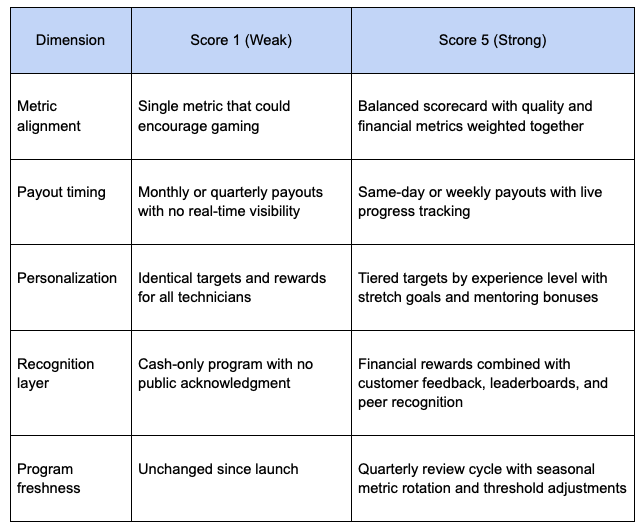
Scoring guide:
- 20–25 points: Your program is well-designed. Focus on incremental optimization and measuring ROI.
- 14–19 points: You have a solid foundation with specific gaps to close. Prioritize the lowest-scoring dimensions.
- 8–13 points: Significant structural issues. Consider pausing the current program and rebuilding with this framework.
- 5–7 points: The program is likely doing more harm than good. A full redesign is the most efficient path forward.
Building a home services incentive program that lasts
The through-line across all five failure modes is the same: incentive programs fail when they are treated as a simple formula (do X, get Y) rather than as a dynamic management system that requires ongoing design, measurement, and adjustment.
The home services companies seeing the strongest incentive program ROI share several traits. They measure multiple outcomes rather than a single metric. They pay attention to timing and make rewards feel connected to the behavior that earned them. They personalize targets so every technician has a realistic and motivating goal. They combine financial incentives with meaningful recognition. And they review and refresh the program regularly so it never goes stale.
If your current program has stalled, the diagnostic framework above will show you exactly where the breakdown is happening. Fix the weakest link first, then work through the rest. You do not need to rebuild everything at once, but you do need to start treating your incentive program as a living system rather than a set-and-forget policy. That shift in approach is how to fix broken incentive programs for good.
For a closer look at how financial incentive tools can support the kind of real-time, multi-metric incentive structure described here, or how to prevent burnout during the seasons when your incentive program is working hardest, those guides dig deeper into the operational side of running a high-performing technician team. And if your incentive program feeds into a broader post-service follow-up workflow, our guide on the real ROI of post-service follow-up shows how those systems connect.
Frequently Asked Questions (FAQs) about technician incentive programs
Why do most technician incentive programs fail?
Most technician incentive programs fail because of structural design problems, not because incentives do not work. The five most common failure modes are measuring the wrong metric, delayed or inconsistent payouts, one-size-fits-all targets, relying on cash alone with no recognition layer, and never updating the program after launch. Fixing even one of these can meaningfully improve results.
What are technician incentive program best practices for home services?
The most effective home services incentive programs use balanced scorecards that weight multiple metrics (revenue, customer satisfaction, callback rate, and membership conversion), deliver real-time or near-real-time payout visibility, personalize targets by experience level, combine financial rewards with public recognition, and run quarterly reviews to keep the program fresh and aligned with seasonal business priorities.
How do you measure incentive program ROI in home services?
Calculate the revenue or retention lift your incentive program generates, then compare it to the total bonus pool paid out. Track metrics like revenue per technician, customer satisfaction scores, callback rates, membership conversion rates, and technician retention before and after program changes. A well-designed program should generate $3 to $5 in measurable value for every $1 spent on incentives.
How often should you update a technician incentive program?
Review and adjust your incentive program at least once per quarter. Evaluate participation rates, payout distribution, metric relevance to current business priorities, and technician feedback. Home services companies should also rotate incentive metrics seasonally to match demand patterns across heating, cooling, and shoulder seasons.
Ready to build an incentive program your technicians actually respond to? Chat with our team.