.svg)
.webp)



Short answer: In 2026, a competitive Google rating for a home services business is 4.5 stars or higher, backed by at least 20–99 reviews and a steady stream of recent ones. A high star rating gets you considered; review volume, recency, and responses are what actually win the call. Among home services companies on the Applause platform, 80%+ maintain a Google rating of 4.8 or higher — a useful target for what "great" looks like in HVAC, pest control, and lawn care.
The rest of this guide breaks down each number: what consumers expect, what top performers achieve, and how the benchmark shifts across the trades.
What counts as a good Google rating in 2026?
Consumer expectations have risen sharply, and the bar is now higher than most owners assume. According to BrightLocal's 2026 Local Consumer Review Survey, 68% of consumers will only use a business with four or more stars — up from 55% the year before — and 31% will only consider a business rated 4.5 stars or higher, nearly double the 17% from a year earlier. At the low end, earlier BrightLocal data found that 71% of consumers wouldn't consider a business rated below three stars.
Here's the practical translation for a home services business:
- Below 4.0 stars: You're being filtered out before the phone rings. This is the danger zone.
- 4.0–4.4 stars: Acceptable, but you're losing the third of consumers who now demand 4.5+.
- 4.5–4.7 stars: Competitive — you clear the threshold most consumers set.
- 4.8–5.0 stars: Where top performers live, and where the 4.8+ Applause benchmark sits.
The takeaway: 4.5 is the new floor for being seriously considered, and 4.8+ is the target if you want to win head-to-head against the best operator in your service area.
How many Google reviews does a home services business need?
Rating alone isn't enough — consumers want proof the rating is real, and that proof is volume plus recency. BrightLocal found that most consumers (59%) expect a business to have between 20 and 99 reviews before they trust its average star rating. Below ~20 reviews, a 5.0 rating reads as "too small a sample to trust"; a deep, current review base reads as "lots of people have used this company and were happy."
Three rules of thumb for review count and cadence:
- Clear 20+ reviews per location, fast. This is the trust threshold. A multi-location operator needs to hit it at every location, not just company-wide.
- Keep them recent. Consumers now use an average of six review sites and weight recent reviews heavily — a wall of five-year-old reviews signals a business coasting on past performance.
- Build velocity, not just volume. A steady flow of new reviews each month is what keeps your rating current and your local search visibility strong.
What do top home services companies actually achieve?
Consumer expectations tell you the floor. First-party platform data tells you what excellence looks like. Applause's analysis behind the inaugural Applause Top 10 Awards examined more than 18,000 data points across nearly 3,000 home services companies, with Google ratings normalized for review volume — and the standout pattern is that the best operators don't just have high ratings, they have high ratings backed by volume and velocity.
The companies that pull ahead treat reviews as a system, not an afterthought. Applause processes 19M+ review requests annually, and companies using the platform generate 7× more reviews than with manual efforts. The clearest example: lawn care company ExperiGreen grew from 3,000 to 13,000 reviews in 18 months — a step-change in both volume and velocity that compounds into local visibility.
Do the benchmarks differ by trade? HVAC vs. pest control vs. lawn care
Yes — mostly because of how often each trade is in front of the customer, which changes how many review opportunities you get per customer per year:
- Pest control and lawn & landscape are recurring, high-frequency services. A quarterly pest plan or a seasonal lawn program puts a technician on the property multiple times a year, which means more natural review touchpoints — if you ask each time. High-frequency trades can build volume and velocity faster, so the competitive review count tends to run higher.
- HVAC is more episodic — a tune-up, a repair, or a replacement that might be years apart. With fewer touchpoints per customer, velocity and recency are harder to sustain, which makes a disciplined, automated ask after every job more important, not less.
Across all three verticals, the underlying benchmark is the same: clear 4.5+ stars, get past 20 reviews per location, and keep a steady flow of recent reviews. What changes is how many at-bats you get to do it — and the high-frequency trades that fail to ask are leaving the most on the table.
How to hit — and hold — the benchmark
Strong review profiles are built on four habits:
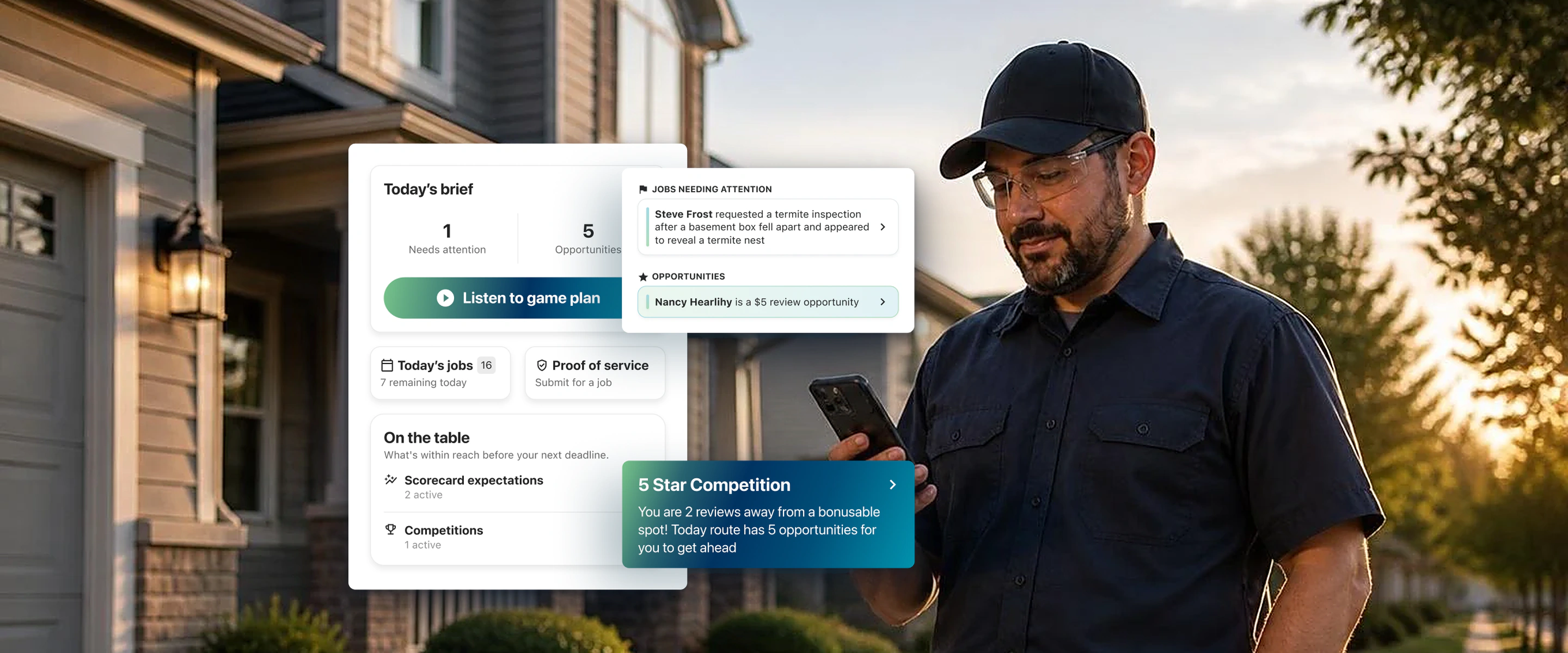
- Ask after every job, automatically. The single biggest reason home services companies under-index on reviews is inconsistent asking. Automating the request right after a completed service is how companies hit 7× more reviews. 5-Star Reviews triggers the ask at the moment satisfaction is highest and ties each review back to the technician who earned it.
- Catch unhappy customers before they post. Measuring NPS & CSAT after each visit surfaces an at-risk customer privately so you can fix the issue — protecting your public rating instead of repairing it after a one-star hit.
- Respond to everything, quickly. Consumers expect a response within a week. The AI Auto Responder helps you reply to every review in a consistent voice without it becoming a full-time job.
- Reward the behavior. When you tie a small, instant bonus to review generation, the ask becomes routine. Performance Incentives automate the payout so technicians feel the win immediately.
Reviews aren't a vanity metric — for a local home services business, your rating and review count are the first thing a prospect sees and a direct input to revenue. Want to see what closing the gap to the 4.8+ benchmark is worth for your business? Run the numbers with the Applause ROI Calculator, or book a demo to see how top operators build their review engine.
Frequently Asked Questions
What is a good Google review rating for a home services business?
In 2026, 4.5 stars or higher is the competitive threshold, and 4.8–5.0 is where top performers sit. BrightLocal's 2026 survey found that 68% of consumers will only use a business with four or more stars and 31% require 4.5 stars or higher. Among home services companies on the Applause platform, 80%+ maintain a Google rating of 4.8 or higher, which is a useful "great" benchmark for HVAC, pest control, and lawn care.
How many Google reviews does a home services business need?
Most consumers (59%) expect a business to have between 20 and 99 reviews before they trust its average star rating, according to BrightLocal. The practical benchmark is to clear at least 20 reviews per location, then keep building — top performers carry 100+ per location. Volume below ~20 makes even a perfect rating look like too small a sample to trust.
Is rating or review count more important?
Both matter, but they do different jobs. A high star rating gets you past the consumer's initial filter, while review volume and recency provide the proof that the rating is real and current. A 5.0 rating with three reviews underperforms a 4.7 with 150 recent reviews, because volume and velocity signal that many customers have used you and been satisfied.
How many reviews should a pest control or lawn care company have versus HVAC?
Recurring, high-frequency trades like pest control and lawn & landscape generate more natural review touchpoints per customer per year, so competitive review counts tend to run higher and build faster — if the company asks at each visit. HVAC is more episodic, with fewer touchpoints per customer, which makes an automated review request after every job more important for sustaining volume and recency. The underlying targets (4.5+ stars, 20+ reviews per location, steady recent volume) are the same across all three.
How quickly should a business respond to reviews?
Most consumers expect a response within a week, per BrightLocal. Responding to all reviews — positive and negative — in a consistent voice signals an engaged business and supports local search visibility. Automating responses with an AI responder makes it feasible to reply to every review without adding manual workload.