

Many home service owners are noticing the same pattern in Google Search Console. Impressions hold steady, yet clicks to the website keep sliding month after month. The natural conclusion is that AI search is taking leads away, even though the phones are still ringing and the schedule is still full.
Impressions and clicks are acting inversely because they measure different stages of the customer journey. AI search now answers many of the questions homeowners used to research on contractor websites, so those visits are disappearing. A homeowner with a failed water heater or a termite swarm in the garage still needs someone at the door, and that call keeps coming.
The real change happens in the step before the call. Google's AI Overviews, AI Mode, Gemini in Google Maps, and ChatGPT now read your listings, reviews, and website to decide which companies to put in front of that homeowner.
This guide explains which clicks AI search is taking, how these tools build a shortlist of local contractors, and what a home service company can fix this quarter to stay on that list.
Why Clicks Are Declining
Home service searches fall into two groups, and AI search treats each group differently:
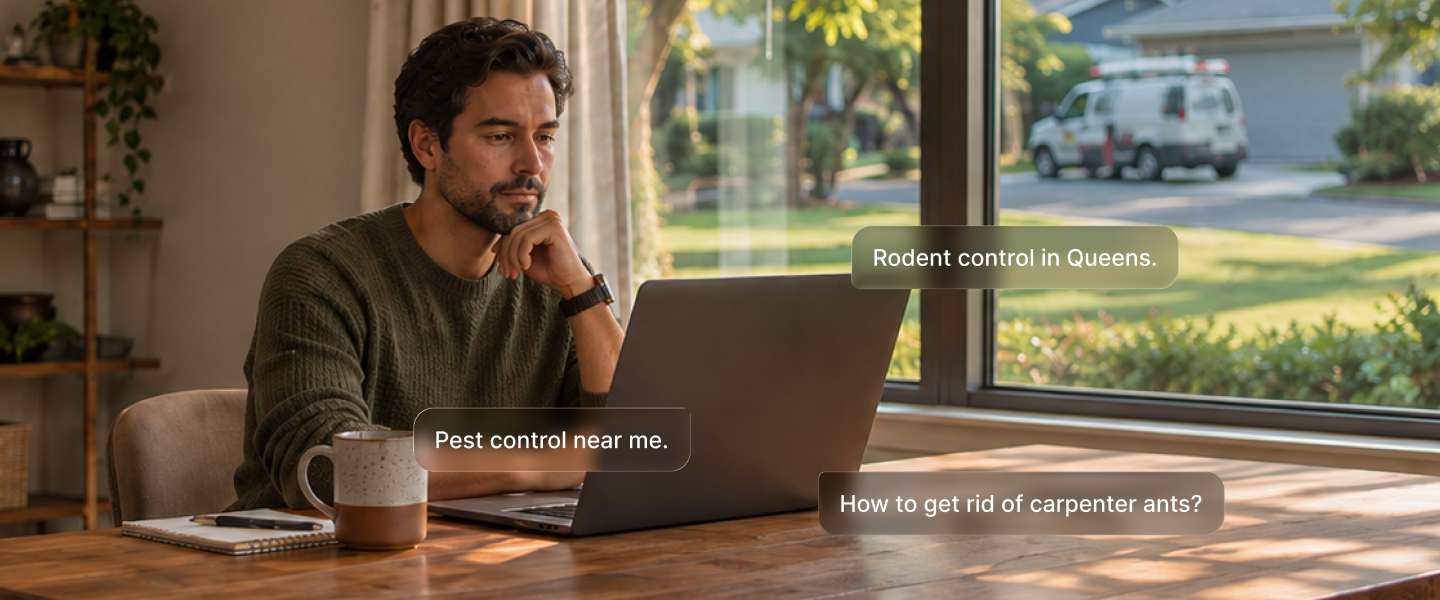
- Informational searches ask why something broke or how to handle it, such as "how to get rid of carpenter ants."
- Service searches ask who can fix the problem, such as "pest control near me" or "rodent control in Queens."
AI summaries absorb most of the informational traffic because they answer the question right on the results page. A Pew Research Center study found that people clicked a traditional search result in 8% of visits when an AI summary appeared, compared to 15% when AI overviews aren’t present.
Service searches look different. Whitespark found there;s AI Overviews on 92% of informational queries and only 15% on local-intent queries, where the map pack still dominates the page.
That split explains the traffic drop. The visits that disappeared are mostly from DIY readers who rarely booked a job, while homeowners ready to hire still land on the map pack and pick up the phone.
Those informational pages are still critical for increasing your site’s ranking.. Seer Interactive found that brands cited inside an AI Overview receive more than twice the organic clicks per impression compared to brands not cited. A blog post that answers a homeowner's question with specific benchmarks and provides a clear solution is the kind of page AI tools quote. The goal for that content shifts from attracting visits to earning citations.
Check Booked Jobs Before Blaming AI
Website sessions measure attention, while revenue comes from calls, form fills, and booked jobs. Those numbers sit in different systems, so a traffic report alone cannot tell you whether AI search is costing you work.
Three steps line them up month over month:
- Split Search Console queries into three buckets: Separate informational, service plus city, and branded searches. A regex filter on question words such as how, why, and what isolates most informational queries in a few minutes.
- Compare each bucket with your lead sources. Set the buckets next to Google Business Profile calls, Local Services Ads leads, tracked calls, and booked jobs in your CRM.
- Ask every new customer where they found you. Add an "AI assistant" option to web forms and the CSR call script, because a homeowner who finds you in ChatGPT often types your URL or calls directly. Analytics records that lead as direct traffic or misses it altogether.
Once those numbers sit side by side, the pattern usually points to a single cause.
How to Diagnose a Drop in Leads from Organic Search
When service clicks and booked jobs hold steady while informational clicks fall, AI search is behaving as expected, and the next step is earning visibility inside AI answers. When service clicks or calls fall as well, the problem sits in local rankings, reviews, or call handling. Fixing those protects revenue faster than any AI strategy.
How AI Tools Build a Contractor Shortlist
Homeowners are adopting these tools quickly. BrightLocal's 2026 Local Consumer Review Survey found that 45% of consumers used ChatGPT or another AI tool to find a local business, up from 6% a year earlier. Each tool builds its shortlist from a different set of sources, which is why a company can appear in one assistant and disappear from another.
BrightLocal's study of nearly 2 million AI citations shows how wide that gap runs:
- Google's AI tools rely on your Business Profile. Google AI Overviews and AI Mode drew on Google Business Profile for nearly every business studied, and for plumbers it accounted for more than half of all AI citations.
- ChatGPT relies on Yelp. Yelp appeared as a source in 80% of ChatGPT's local answers. In July 2026, Yelp agreed to license its reviews, photos, and business details to OpenAI, and its Request a Quote feature is coming to ChatGPT. So homeowners will be able to contact a contractor without opening the contractor's website.
- Your website feeds every platform. Individual business websites made up the vast majority of cited domains, because AI tools pull service details, service areas, and credentials directly from company pages.
This is where inconsistent business information starts costing jobs. When your phone number, hours, or service area differ between Google, Yelp, the BBB, and your website, every assistant receives conflicting facts, and a competitor with clean, matching data becomes the easier company to recommend.
Reviews Are Now Read by AI Too
Google Maps now places a Gemini-written review summary on business listings, and BrightLocal found that 82% of consumers read these summaries. Each summary condenses the themes that repeat across your reviews. When dozens of customers mention that the technician arrived on time, explained the price before starting, and cleaned up afterward, the summary reflects that.
When several mention surprise charges, that complaint appears instead, directly above your star rating. As a result, consistent work from the field team across hundreds of jobs now shapes the first paragraph a homeowner reads about your company.
Recency carries equal weight, because summaries and homeowners both lean on recent feedback. Applause has covered why review velocity drives map pack rankings, and that same steady flow of fresh reviews gives AI summaries current material to draw from. Two rules keep that flow compliant and effective.
- Send open review requests after the visit. Google's April 2026 policy update restricts asking customers to include specific content in a review, including a technician's name, and requests should go out after the technician has left the home. Applause's breakdown of the policy covers compliant wording.
- Reply to every review in your own words. Half of consumers are put off by generic, templated replies, so a specific response does more for your reputation than a fast template.
Yelp requires a different approach, because its guidelines prohibit asking customers for reviews. Claim and complete the profile, keep its details identical to your Google listing, and reply to the reviews customers leave on their own.
Platforms like Applause handle the repeatable part of this work. A review request goes out automatically after each completed job, and AI-drafted responses help the office reply to every review without adding hours to the week.
Search Challenges to Fix This Quarter
The companies AI tools recommend tend to share the same groundwork, and these six steps build it, starting with measurement.
- Split reporting by search intent. Track informational, service, and branded clicks separately, then tie each group to calls and booked jobs so a drop in DIY traffic never gets mistaken for a drop in customers.
- Run an AI visibility check. Pair five core services with your four largest service towns and run those 20 prompts in ChatGPT, Google AI Mode, and Ask Maps. Record which companies appear and which sources each tool cites, then repeat the check every quarter.
- Complete your Google Business Profile and match it everywhere. Set accurate categories, list every service, define service areas, publish emergency hours, and add current photos of trucks, crews, and finished work. Then copy the same name, phone number, and hours to Yelp, the BBB, Angi, Apple Business Connect, and Bing Places.
- Rebuild service pages around verifiable facts. State license numbers, guarantee terms, the towns you serve, typical response times, and your diagnostic fee or price ranges. Add LocalBusiness and Service schema with the areaServed property so search engines and AI crawlers read those details without guessing.
- Rework old DIY posts. Keep the posts that still bring in calls, rewrite the rest into "when to call a pro" guides with clear thresholds, and merge thin posts that answer the same question.
- Reply to reviews within a day. Fast, specific responses show homeowners an attentive business and keep your profiles active across every platform.
The Bottom Line
AI search took clicks from informational searches first, which is why the traffic line fell while the phones kept ringing. Local service searches still run through the map pack, Google Business Profile, and reviews.AI assistants read those same sources when they decide which contractor to name.
The companies that make the shortlist keep matching information on every listing, earn a steady flow of recent reviews, and publish service pages with facts an AI tool can verify. Each of those sits within a home service company's control this quarter.
About Dijital Karma. Dijital Karma is a digital marketing agency for pest control and home service companies, running Google Ads, local SEO, landing page, and AI & automation programs. To see how your company appears in ChatGPT, Google AI Mode, and Maps, and what keeps you off the shortlist, reach out to our team for an AI visibility check.