.svg)




As a lawn care company, the price you charged a customer in 2024 doesn't cover the cost of serving them in 2026. Occasional price increases are just part of running a business.
But at a certain point, price increases create a much more expensive problem: customer churn.
In home services, customer retention is everything. According to Bain & Company's loyalty research, a 5% reduction in customer defection can lift profits by 25% to 95%, and acquiring a new customer costs anywhere from 5 to 25 times more than retaining an existing one.
This guide breaks down why prices are rising, why lawn care customer retention is the cheapest growth lever you have in 2026, and the specific plays that work to reduce churn when budgets are tight on both sides of the truck.
Why lawn care prices are rising in 2026
The number one reason lawn care companies are raising prices in 2026 is fuel. The other line items pile on from there.
Fuel is the single biggest driver
The U.S. Energy Information Administration's April 2026 Short-Term Energy Outlook forecasts retail gasoline averaging $3.70 per gallon for the year, with a peak near $4.30 per gallon in April. Diesel is worse: an average of $4.80 per gallon, peaking above $5.80 per gallon in April. The EIA raised its fuel price projections for both 2026 and 2027 earlier this month.
For a lawn care fleet that burns 500 gallons per truck per month, even a 30-cent swing per gallon adds up to $1,800 per truck per year. Across a 25-truck operation, that's $45,000 in margin you're either eating or passing along.
Commercial auto insurance keeps climbing
Insurance for service vans averages $2,500 to $3,300 per vehicle per year, before a single claim is filed. Repair labor was up nearly 5% year over year heading into 2026, with parts prices projected to rise another 15% to 25%. Carriers price all of that into renewal.
Labor and materials
Crews still cost more than they did two years ago, fertilizer prices are sticky, and equipment parts are pricier. None of that is going back down in 2026.
Here's a quick look at what's actually changing on your P&L:

It’s a grim picture. But there are several ways mid-sized home services companies can save $100K+ per year on their fleets alone to cut costs without raising prices for customers.
Keeping a client is the highest-ROI move you can make
Lawn care benchmarks for 12-month customer retention sit between 80% and 92%, with the top operators consistently above 90%, according to Lawn & Landscape. Every percentage point you move that number is worth real money.
Two numbers from Bain & Company's loyalty research frame the case:
- A 5% reduction in defection can increase profits 25% to 95%.
- Acquiring a new customer costs 5 to 25x more than retaining one.
Now apply that to a typical residential lawn care customer at a $1,200 annual contract. The longer you keep them, the more profitable every other dollar in your business becomes.

That CLV table is why a 7% churn rate isn't a small problem. It's the difference between a customer worth $1,200 and one worth $9,000+.
Communicate the price increase the right way
Most cancellations are more about how the price increase was communicated and less about the actual price increase itself.The fix is unglamorous and very effective:
- Give 30+ days' written notice. Email and customer portal. No phone-only notifications. Customers need time to absorb it.
- Lead with what's included, not with the apology. List the visit count, the treatments, the response time, the warranty. The customer needs to remember the value before they see the new number.
- Anchor against the macro reality. One sentence on fuel costs and insurance. You're not the only company raising prices, and customers know it.
- Offer a lock-in option. Let loyal customers prepay annually at the old rate, or sign a 24-month agreement that splits the difference.
- Train every CSR on a one-page rebuttal script. The customers most likely to cancel are the ones who call in. Whoever answers that call decides whether you keep them.
Customers who feel respected during a price increase don't churn. Customers who feel surprised, condescended to, or ignored, do.
Use reviews as a retention moat, not just a lead source
Most lawn care owners think of reviews as an acquisition channel. They're also one of the strongest retention signals you have. A customer who has publicly committed to a 5-star review of your company is dramatically less likely to cancel. Behavioral economists call it the consistency principle. You can call it free retention.
Three plays that work:
- Automate review requests at the moment of peak satisfaction. Right after a successful visit. Not a week later in a batch email.
- Respond to every review, positive and negative. Public responses signal accountability to existing customers, not just prospects.
- Stay compliant with Google's incentive rules. Google forbids paying customers for reviews or explicitly requesting that customers include specific content in their online write-up.
And don't ignore Facebook. Facebook reviews influence local search, repeat purchases, and referrals from people who don't search Google for service providers.
Use crew incentives and recognition to cut churn at the source
Most cancellations don't trace back to a price. They trace back to a missed visit, a sloppy edge, a tech who didn't introduce himself, or a callback that took three days. Crew quality is retention. Full stop.
What works:
- Tie technician bonuses to the metrics that matter to customers. NPS, review volume, and reservice rate. Not just speed.
- Use real-time recognition. Digital tips and instant bonuses delivered the same day reinforce good behavior far more effectively than a quarterly check.
- Make the leaderboards visible. Peer competition raises fleet-wide averages. The Fleet Savings Playbook found that one operator cut at-fault incidents by 70% over two years after putting driving scores in front of every tech.
Both are direct retention math: tech turnover is one of the biggest drivers of customer churn nobody puts on a P&L.
Cut the costs your customers don't see, before raising the ones they do
Before pushing another price increase, audit the costs you actually control. Fleet is the largest hidden line item in most lawn care P&Ls, and the savings opportunities are bigger than most owners realize.
A 50-truck fleet typically leaves $100,000+ on the table every year, and a 250-truck fleet leaves $1M+. The savings come from layering a few systems together, not from any single tool.

If you can save $40,000 on fuel and $60,000 on insurance, you can hold a price increase to 4% instead of 8% — and the customers you don't lose because of it more than pay for the technology that got you there.
Build a retention dashboard you actually look at every week
Retention only improves when you measure it. Most lawn care owners track revenue and crew hours weekly but only look at churn quarterly, by which point the cancellations have already happened. The fix is a small dashboard, reviewed every Monday, with clear ownership.
The metrics that move retention:

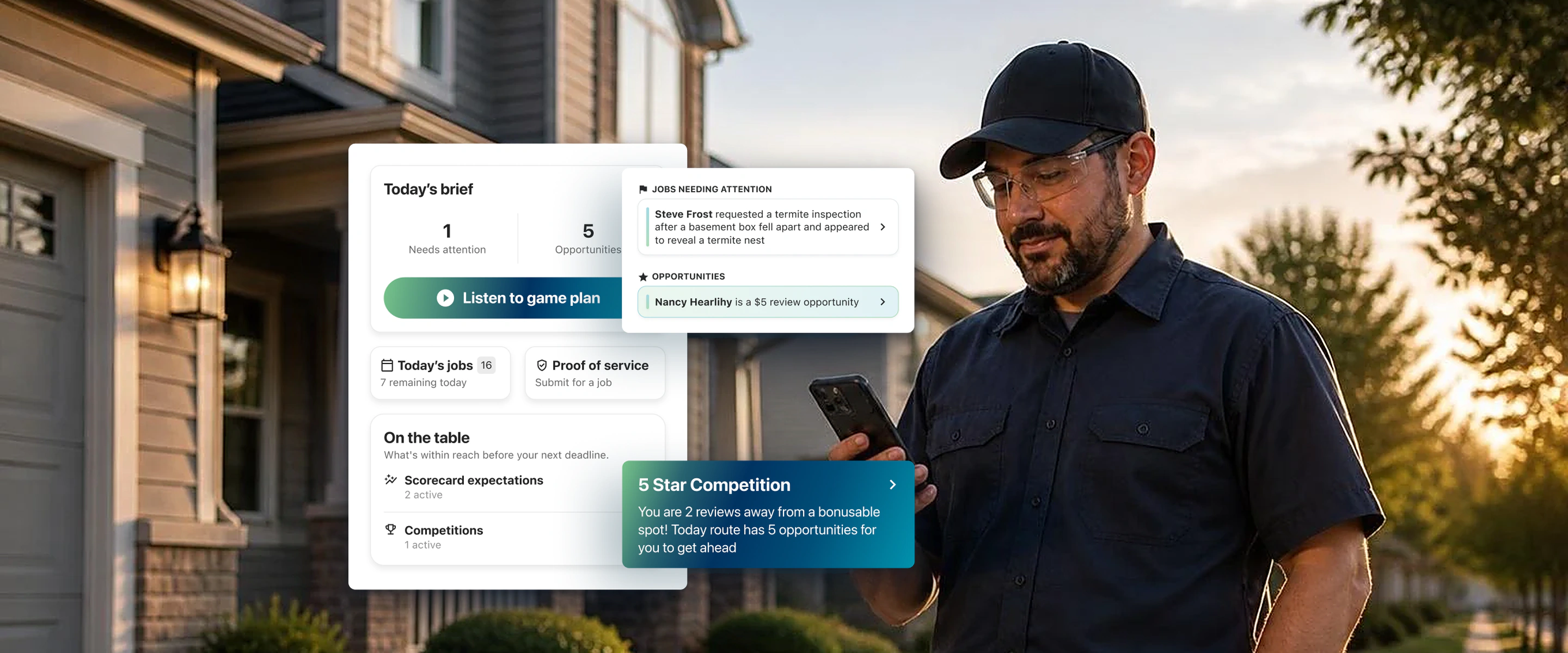
Track most of these in Applause, and reward your techs for moving them
You don't need a separate tool for each metric on that list. Applause pulls data from your CRM, dispatch software, fleet management software, and review platforms into a single real-time view of performance — by technician, by route, and by team.
On the customer experience side, Applause tracks:
- NPS response rate and score, by tech and by route
- Google and Facebook review volume, average rating, and rating velocity
- Reservice and callback rates
- Time on site
- Tip volume and recognition events
On the fleet and safety side, Applause Scorecards centralizes driving metrics pulled directly from your fleet management software, including:
- Driving days and overall driving score
- Acceleration score and harsh acceleration count
- Braking score and harsh braking count
- Cornering score and harsh turning count
- Speeding score and excessive speeding events
- Distracted driving and cell phone usage
- Idling score
- Seatbelt usage
- Forward collision warnings, tailgating, unsafe lane changes, and stop sign violations
- Drowsy driving detection
- Driver-facing camera obstruction events
- Unsafe parking events
All of those metrics update daily, automatically. Applause organizes the data into a clear month-over-month view so you can spot drift before it becomes a claim, an accident, or a customer complaint.
The bottom line
Customers will accept price increases from the lawn care company that earns their loyalty through visible quality, consistent communication, and fair value.
The companies losing the most clients in 2026 are the ones raising prices without doing the retention work first. Cut the costs your customers don't see, sharpen the experience they do see, measure it weekly, and pay the techs delivering it. Do that, and a price increase becomes a margin-protection move instead of a churn event.
Ready to keep more customers for the long-haul? Chat with our team about how Applause can help.
Frequently asked questions
What is a good customer retention rate for a lawn care company?
Industry benchmarks put lawn care customer retention between 80% and 92%, with the top operators consistently above 90%. If your 12-month retention is below 80%, the issue is almost always either crew quality or follow-up communication.
How much should I raise lawn care prices in 2026?
Most lawn care companies are landing somewhere between 4% and 8% in 2026, driven primarily by fuel costs (gasoline forecast at $3.70/gal and diesel at $4.80/gal per the EIA's April 2026 Short-Term Energy Outlook), insurance, and labor. The right number for your business depends on how much margin you've already lost and how much fleet cost you can claw back before passing the rest along.
How do I tell customers I'm raising prices without losing them?
Give 30+ days' written notice, lead with the value included in the service, anchor against the macro reality so they know everyone is doing it, offer a prepay or multi-year lock-in option, and train your CSRs on a clear rebuttal script. Customers who feel respected don't churn.
What's the cheapest way to reduce churn in a lawn care business?
Tie technician compensation to the metrics that matter to customers — NPS, review volume, reservice rate. It costs you almost nothing if you're paying out of money you would otherwise lose to cancellations, and it improves the on-site experience that drives most retention decisions.
How do reviews affect customer retention?
Customers who leave a public 5-star review are significantly less likely to cancel. The act of publicly endorsing your business creates a psychological commitment, and the visible response from your team signals you'll show up if anything goes wrong. Treat reviews as a retention tool, not just a lead generation tactic.
.webp)