.svg)




You do great work. Your customers are happy. But your Google review count is stuck. A trickle of new reviews come in every month while your competitors seem to be racking them up week after week.
Countless home services businesses are stuck in this holding pattern. The fact is, getting more Google reviews rarely comes down to the quality of your service. It comes down to whether you have a systematic way of asking for them. Most home services businesses don't, and they're leaving one of their most powerful sales and marketing tools sitting on the table.
This guide breaks down exactly how to get more Google reviews for your HVAC, lawn care, pest control, or plumbing business consistently, compliantly, and without it feeling like begging.
Why Google reviews are make-or-break in home services
Google reviews are not just a vanity metric. They are a core part of how your business wins (or loses) new customers every single day.
Consider this: 81% of consumers rely on Google reviews when evaluating local businesses. For home services, where trust is everything — you're letting a stranger into someone's home — that number is likely even higher.
A potential customer searching for an HVAC company at 9pm in August isn't reading your website. They're reading your reviews.
Reviews also directly impact your local search ranking.
Google's algorithm rewards businesses that have a high volume of recent, quality reviews by surfacing them higher in the Map Pack — those coveted top three local results that capture the lion's share of clicks. Getting into the Map Pack is one of the highest-ROI moves a home services business can make, and your review velocity plays a major role in getting there.
Put simply: more reviews = more trust = more calls = more booked jobs.
The problem: Most home services companies don't have a system
Data from a recent analysis of post-service follow-up found that 72% of customers will leave a review if they're asked after a completed job. Yet most home services companies don't have a consistent process to make that ask happen.
Instead, the office sends a generic email a week later that's inevitably ignored.
The fix isn't complicated. But it does require intention and a repeatable process that takes the guesswork out of when, how, and who asks.
First, know the rules: What Google's review policy actually allows
Before building your review strategy, you need to understand where the guardrails are. Google has specific policies around how businesses can solicit reviews, and violating them can result in reviews being removed. Worse, your Google Business Profile may be penalized.
Here's the short version of what you need to know:
- You can ask customers to leave a review. There's nothing wrong with requesting a review after completing a job.
- You cannot offer incentives in exchange for reviews. Discounts, gift cards, free service — anything that compensates a customer for leaving a review (positive or negative) is against Google's guidelines.
- You cannot selectively ask only happy customers. Known as "review gating," this practice — where you screen customers first and only send satisfied ones to Google — also violates the policy.
- You cannot ask employees or third parties to write fake reviews. This one should go without saying, but it's worth being explicit.
The good news: compliant review generation works. You don't need to game the system; rather, you need a process that makes asking easy. For a deeper breakdown, this post on Google's rules for incentivizing reviews is a must-read before you build your strategy.
The most effective tactic: Technician-driven review collection
If you want to dramatically increase your Google review volume, this is the biggest lever you can pull: get your technicians involved in the ask.
Think about the moment a job is finished. The customer just watched your tech diagnose a tricky issue, fix it cleanly, and leave the house more comfortable than when they arrived. That is the highest-trust moment in the entire customer journey, and it's the single best time to ask for a review.
An automated email sent three days later can't replicate that.
Here's what makes technician-driven review collection work:
- Train your team on the ask. Give them a simple script and practice it. Most technicians feel awkward asking for reviews because they've never been coached on how to do it naturally.
- Give them a tool to send the review link immediately. The moment of ask should come with an immediate, frictionless path to action — a text message or QR code that takes the customer directly to your Google review form.
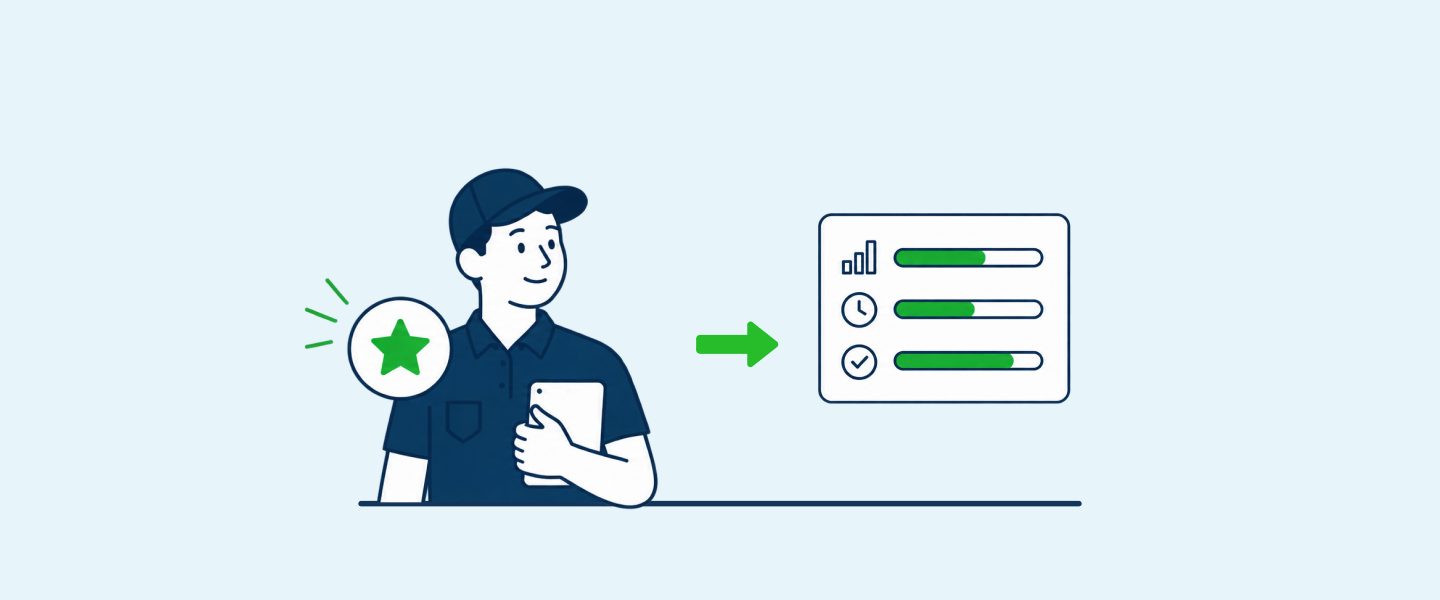
- Tie it to recognition. When technicians know that reviews reflect on them individually (and that great reviews are recognized and rewarded), they become invested in collecting them. Real-time feedback loops can transform your team's engagement with this process.
When your technicians own the review ask, your review volume will follow.
Use SMS review requests and make them immediate
According to Mailchimp's email benchmarks, average email open rates for home services businesses run around 20–25%. SMS open rates, by contrast, are widely reported to be well above 90% (driven largely by the simple fact that most people read a text within minutes of receiving it.) If you're only following up via email, you're losing the majority of your review opportunities before a customer ever reads your message.
SMS review requests work because they're:
- Immediate. A text sent within minutes of job completion reaches the customer while the experience is still fresh.
- Frictionless. One tap on a link and they're on your Google review page.
- Personal. A short, genuine message reads as a direct ask — not a mass marketing blast.
A good SMS review request doesn't need to be long. It just needs to be timely, authentic, and direct. Think something like:
"Hi [First Name]. Thanks so much for choosing [Company Name] today. If [Technician Name] did a great job, we'd love a quick Google review. It means the world to our team: [link]"
Notice a few things: it uses the customer's name, it names the technician (personalizing the connection), and it makes the action easy with a direct link. Short, human, and effective.
Nail the timing: Ask when satisfaction is highest
The timing of your review request is just as important as the channel. Ask too late, and the customer has moved on. Ask at the wrong moment (like when they're still waiting on a part or a follow-up visit), and you risk a lukewarm or negative review.
The optimal window to ask for a review is immediately after job completion. Ideally within the first hour. Research on timing in customer feedback consistently shows that satisfaction peaks at the moment of resolution, then gradually fades. The longer you wait, the lower your review response rate and the less enthusiastic the review content tends to be.
For home services, a simple trigger works best: when a technician marks a job complete in your field service management software, that action automatically triggers a review request SMS to the customer. No manual follow-up required.
What to say and what to avoid
The language of your review request matters. A few principles to keep in mind:
Do:
- Ask genuinely and directly: "We'd love a Google review if you're happy with today's service"
- Reference the specific technician or job when possible
- Make it easy with a direct link to your Google review page
- Keep the message short. Two to three sentences is ideal for SMS
Don't:
- Offer anything in exchange for the review (see the policy section above)
- Use language that pressures or guilts the customer
- Ask customers to "leave a 5-star review" (Google explicitly prohibits soliciting specific ratings)
- Send review requests more than once per job (one follow-up is fine; repeated asks feel spammy)
The goal is to make the ask feel like a natural extension of the customer experience. When it's done right, most customers are genuinely happy to help.
Build a system, not a one-off campaign
The businesses that consistently outrank competitors on Google reviews aren't running a review "campaign." They're running a review system: a repeatable process that generates reviews automatically, every day, without requiring a manager to chase it down.
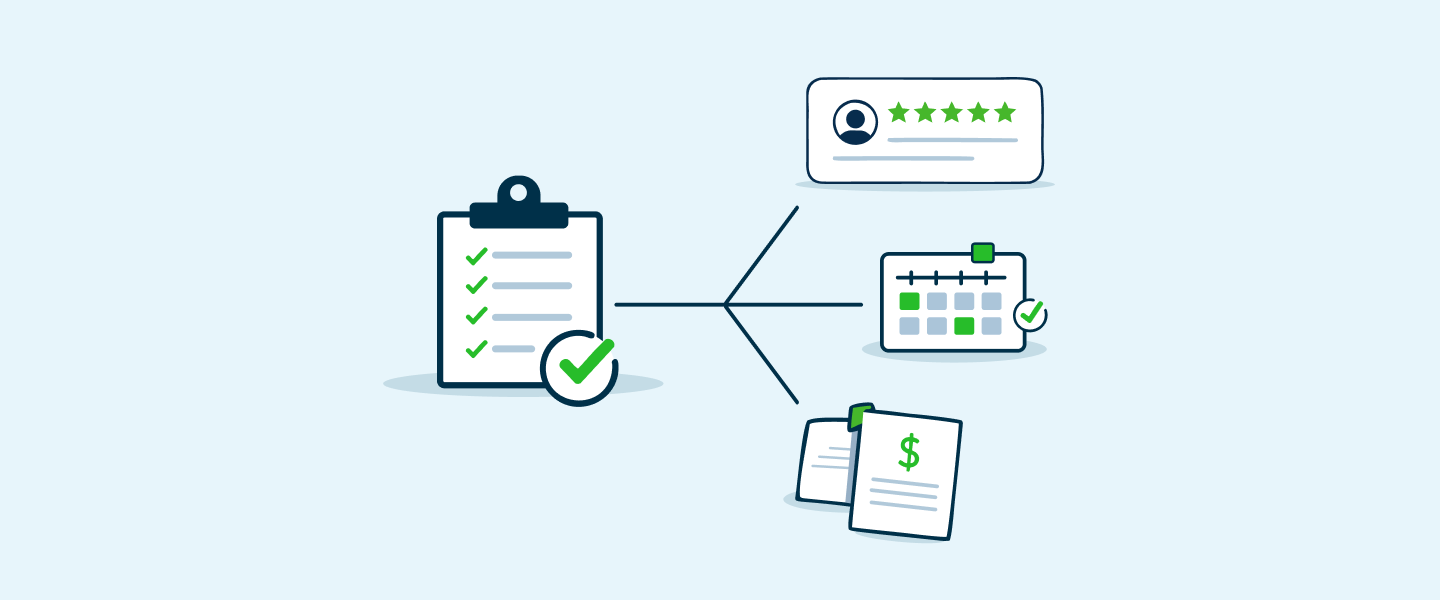
A basic review system for home services looks like this:
- Job completed → technician marks job done in FSM software
- Automated trigger → SMS sent to customer within 15 minutes of job close
- Direct link → customer taps the link and lands on your Google review page
- Review posted → notification goes to the office and the technician's scorecard
- Response → someone on your team responds to the review within 48 hours
That last step, responding to reviews, matters more than most businesses realize. Google sees owner responses as a signal of engagement. And customers who are considering hiring you are reading those responses just as carefully as they're reading the reviews themselves.
This systematic approach is also what separates reputation management from reputation luck. The power of an always-on review system compounds over time: each month of consistent review collection builds on the last, widening the gap between you and competitors who are still relying on happy customers to remember to post on their own.
Don't stop at Google, but start there
Google should be your primary review focus, but it doesn't have to be your only one. Studies show that 74% of consumers use more than one review platform when researching local businesses. Depending on your market, platforms like Facebook, HomeAdvisor, or Yelp may drive meaningful traffic as well.
If you're already generating a consistent flow of Google reviews, consider rotating your review request links periodically to build volume across other platforms. Google reviews alone may not be enough for home services businesses looking to dominate their local market. Adiversified presence builds trust across every touchpoint where a potential customer might find you.
Track your review volume and connect it to technician performance
If you're not measuring it, you can't improve it. Here are the numbers worth tracking on a monthly basis:
- Total new reviews: are you trending up, down, or flat?
- Average star rating: what's your current overall rating, and is it improving?
- Reviews by technician: who's driving the most reviews, and who needs coaching?
- Review request conversion rate: what percentage of customers who receive a request actually leave a review?
- Response rate: are you responding to reviews consistently?
Breaking reviews down by technician is particularly powerful. It creates healthy competition, gives managers clear coaching opportunities, and connects individual performance to measurable outcomes, which is one of the most motivating things you can do for a field team. When a technician can see that their reviews are directly tracked and recognized, they take the ask seriously.
You can also tie your review data to broader customer satisfaction metrics. NPS scores, for example, can help you identify your most loyal customers, who also happen to be the ones most likely to leave a detailed, enthusiastic review if asked at the right moment.
The bottom line
Getting more Google reviews isn't about luck, and it's not about having a perfect five-star business. It's about having a system.
Ask at the right moment. Use the right channel: SMS over email, technician-led over automated-only. Stay compliant with Google's policies. And make the whole process automatic so it happens on every job, every time, without anyone having to think about it.
The home services companies building the biggest review moats aren't doing anything magical. They've just made the ask a non-negotiable part of every service call, and they've given their team the tools to do it effortlessly.
That's how you go from a handful of reviews to hundreds. And from hundreds to the undisputed reputation leader in your market.
Ready to build your review system?
Applause helps home services companies automate compliant review collection, track performance by technician, and turn every completed job into a reputation-building opportunity. See how it works for your business.


.webp)