.svg)




A technician finishes a tough repair, the homeowner is thrilled, and a glowing five-star review goes up an hour later. The tech who earned it may never see it. The review benefits the business, but the tech moves on to the next job, and the one thing that would have made their day disappears into a dashboard or spreadsheet they don't have access to.
That gap is the culprit of many of the performance problems owners see in low performers. Techs work alone, often for eight hours or more a day, with little idea how they're doing or whether anyone notices until a quarterly performance evaluation. That kind of isolation can lead to increased burnout, procrastination, and anxiety.
If your technicians are underperforming, it's rarely a matter of laziness; It’s usually a systemic problem: Great work goes unseen, feedback shows up weeks late, and rewards aren't tied to the moments that matter.
In this article, we'll share what our research shows actually motivates technicians. Then we'll cover five strategies you can put in place to close the visibility and performance gap that prevents techs from performing at the top of their game.
The Largest Drivers of Motivation for Technicians
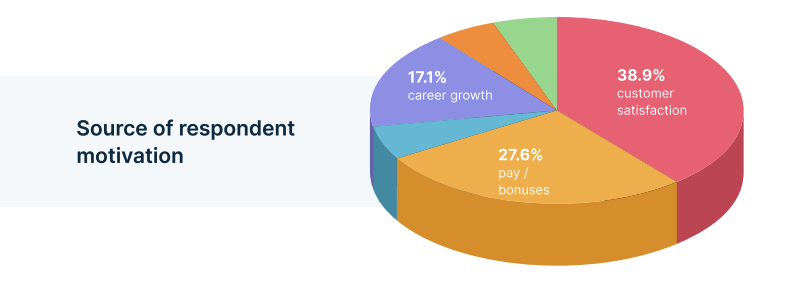
Earlier this year, we surveyed 550+ in-field technicians for our 2026 State of Home Services Benchmark Report. One of the questions was simple: "What motivates you most in your work?"
We expected pay to win and be the top motivating factor. It didn't, and it wasn’t.
Here’s what techs specified motivated them the most in the workplace:
- Customer satisfaction: 38.9%
- Pay and bonuses: 27.6%
- Career growth: 17.1%
- Recognition: 9.4%
- Positive team culture: 4.4%
What These Findings Tell About Employee and Technician Motivation
Techs are intrinsically motivated and want to provide exceptional service
The intrinsic theory of motivation finds that humans are more driven to engage in certain behaviors because they find them personally interesting. Technicians love solving challenges and the tangible impact that has — creating happy customers and feeling the satisfaction of a job well done.
Pay is the foundation, not the ceiling
Financial incentives were cited as a clear second driving motivator. Pay has to be right before anything else can work. This is further supported by Maslow’s Hierarchy of Needs, which shows that safety needs must first be met before a higher motivation emerges. Once compensation is satisfactory, the things that set top performers apart are purpose, progress, and connection.
Recognition and culture matter more than techs may realize
Only 9.4% named recognition and 4.4% named team culture as a top motivator. But people tend to underrate social factors when describing what drives them, even as isolation quietly drags on their performance. The lesson isn't to ignore recognition, it's to tie recognition to what techs already care about: happy customers and real rewards.
Career growth is an emerging motivator that organizations can’t ignore
The 17.1% motivated by advancement reflects the younger or early-tenure cohort looking for clear skill ladders and promotion paths. Operators that can articulate growth opportunities will be better positioned to retain their rising performers.
Now equipped with this knowledge, it’s critical to know how you can leverage it to motivate techs and channel that energy towards actions that increase revenue.
Top 5 Employee Motivation Strategies that Accelerate Technician Efficiency and Revenue Growth
1. Set Goals With Your Top Techs In The Room
Techs are motivated by impact, so show them exactly how their daily work connects to business results. Bring your top performers into a planning session and map business outcomes (revenue, retention, reviews) to technician daily actions that drive them. Use SMART goals to spell out what management will provide and what techs will own. When your best techs help set the targets, the rest of the team is more likely to buy in, because the goals come from peers, not just the front office.
2. Incentivize 3–5 Behaviors At A Time, Each With A Clear Start And End Date
Pay is tech’s second-biggest motivator, but spreading bonuses across a dozen metrics dilutes their effectiveness. Pick the three to five behaviors that will move the needle the most in growing the business. Focus on actions techs directly control, like asking for reviews or referrals. Then attach a time-bound incentive to each.
For example, double your $5 review bonus to $10 for 30 days. A clear end date creates urgency, and rotating your focus metrics keeps the program fresh.
3. Move from Periodic to Instant Feedback and Recognition
A monthly performance review means technicians are course-correcting weeks after the moment that matters has already passed — and in that gap, silence gets misread as "no news is good news.”
By giving technicians a real-time view of their own performance, they can see and adjust in the moment rather than waiting on you. Pairing that visibility with instant recognition, like a same-day bonus or a kudos the second a five-star review comes in, ensures the reward lands close enough to the behavior that led to the accomplishment.
4. Cultivate A Customer-Obsessed Culture With Competitions And Leaderboards
Techs value the independence of the job, but long days alone in a truck can get lonely. When that loneliness sets in, performance slips. Competitions give a scattered team a shared goal and a reason to check in with each other.
Build competitions around the metrics that drive revenue, like reviews, memberships sold, or first-time fix rate. Keep standings visible and update them in real time. Friendly competition turns routine tasks into goals worth achieving and can get a team back on target fast.
5. Offer Ongoing Training Based On Core Challenges Identified In Team Surveys And Customer Reviews
Mine for patterns to find exactly where those gaps live — whether that’s a less-than-successful CRM script or confusing communication around proof of service— then build training around those gaps and pair struggling techs with top performers. Techs who feel invested in are more likely to stay, and more likely to grow into the tech your business actually needs.
Putting these five strategies into practice requires having the right performance incentive system that provides the insights and motivates technicians to perform their best.
If Great Work Is Visible And Rewarded, Motivation Follows
Your technicians aren't lazy. Most of them are working alone in a truck with no view of how they're doing, and it's easy to feel unseen out there. Our survey shows that techs are driven by the work itself: happy customers, a job done right, and a clear path to career progression and individual growth. Pay matters, but it's only the foundation. What moves the needle is making performance visible and making sure every tech feels part of something bigger.
This is why we built Applause to provide owners with the tools necessary to turn all technicians into top performers:
- Scorecards empower owners to set KPIs that reflect business goals, while techs are able to track their performance in real-time and get auto-award the right behaviors when targets are hit out in the field.
- Competitions enable owners to build challenges around the KPIs that matter most, allow techs to view their real-time standings in the app, and reward winners instantly, all without the hassle of tracking performance via whiteboards, emails, or spreadsheets.
- Performance AI gives technicians the context and guidance they need to work more efficiently, deliver consistently great service, and maximize every customer interaction.
Ready to close the performance gap? Book a demo to see how Applause transforms techs into top performers, and transforms their excellent service into automatic growth for your business.