


Two pest control technicians can run similar routes, use the same products, and still produce very different results by the end of the year.
The first tech finishes every stop, asks customers about their concerns, and builds relationships that turn routine visits into new revenue. The second tech’s treatments are just as thorough, maybe even better. But they rarely talk with customers beyond a quick hello, so problems go unmentioned and opportunities go unnoticed. Despite doing great work, they aren’t growing the business as much as they could.
The difference between a top performer who grows the business and a tech who doesn’t usually isn’t a difference in talent. It’s habits, and habits can be taught.
If you want to grow your pest control business without spending additional on paid leads that may not convert, building a culture around technician-led revenue is the place to start.
In this article, we’ll cover why techs are your biggest growth lever, what keeps average performers from reaching the top, and the five habits top pest control technicians practice on every job, plus how to build each one into your team’s culture.
Why Your Pest Control Technicians Are Your Biggest Growth Lever
Your technicians are your biggest growth lever because they’re the only people in your company who see the customer’s property on every visit. That makes them your best source of new revenue, your strongest retention tool, and the face of your brand, all at once.
Take a routine quarterly general pest service. An average tech sprays the perimeter, knocks down a few webs on the eaves, and heads to the next stop.
A top performer does the same treatment, but they typically go the extra step by noticing other problems such as:
- Small gaps in the foundation that mice, rats, or other rodents could nest in
- Mud tubes where the soil meets the exteriors of homes, which could point to a termite issue
- Areas where standing water could collect, which could increase mosquito activity in humid months
Relying just on marketing and sales to generate revenue leaves growth opportunities like these on the table unfulfilled. With gas prices at all-time highs, materials eating up 20% or more of operating costs, and it being 7x more costly to acquire new customers than it is to keep an existing one, pouring more money into paid leads becomes harder to justify.
The reality is that the pest control and lawn care companies still growing margins are investing in one core area: Tech-generated leads.
Here's why:
Technicians Are Your Lowest-Cost Lead Source
Technicians are your cheapest lead-gen source, even if you pay them an incentive for every qualified lead. Coalmarch Marketing places the average cost per lead at $111 for pest control and $90 for lawn care. Let's say you pay each tech a spiff of $10 per lead generated. Comparing that with paid sources, your techs would be saving you 89-91% per qualified lead.
Tech-Generated Leads Close at Up to 14x the Rate of New Prospects
Tech-generated leads aren’t just cheaper; they close more often. Pestcom’s technicians submitted 322 leads in six months due to incentivizing them with a $10 spiff. 70% of those tech-generated leads closed. Compare that to the 5–20% success rate of selling to a new prospect.
Techs Protect Your Recurring Revenue
Recurring maintenance plans account for 85% of revenue generated by residential pest control services. As a result, a cancellation doesn’t typically mean lost revenue on one visit, but on multiple. Most of these cancellations can be prevented, and technicians have the best chance to—by providing excellent customer service.
Small improvements add up. According to Kemp Anderson, a PCT consultant, a 2% increase in customer retention has a similar effect to decreasing expenses by 10%. Here’s what that means for a single route:
The average pest control technician produces $136,250 a year. Keeping just 2% more of that tech’s customers protects about $2,700 in revenue per route. Across a team of 10 techs, that’s $27,000 a year, without spending another dollar on ads.
What Prevents Pest Control Technicians from Becoming Top Performers
Most technicians don’t fall short because they lack skill or work ethic. They fall short because the way they’re managed doesn’t support the habits that grow revenue. Four barriers come up again and again.
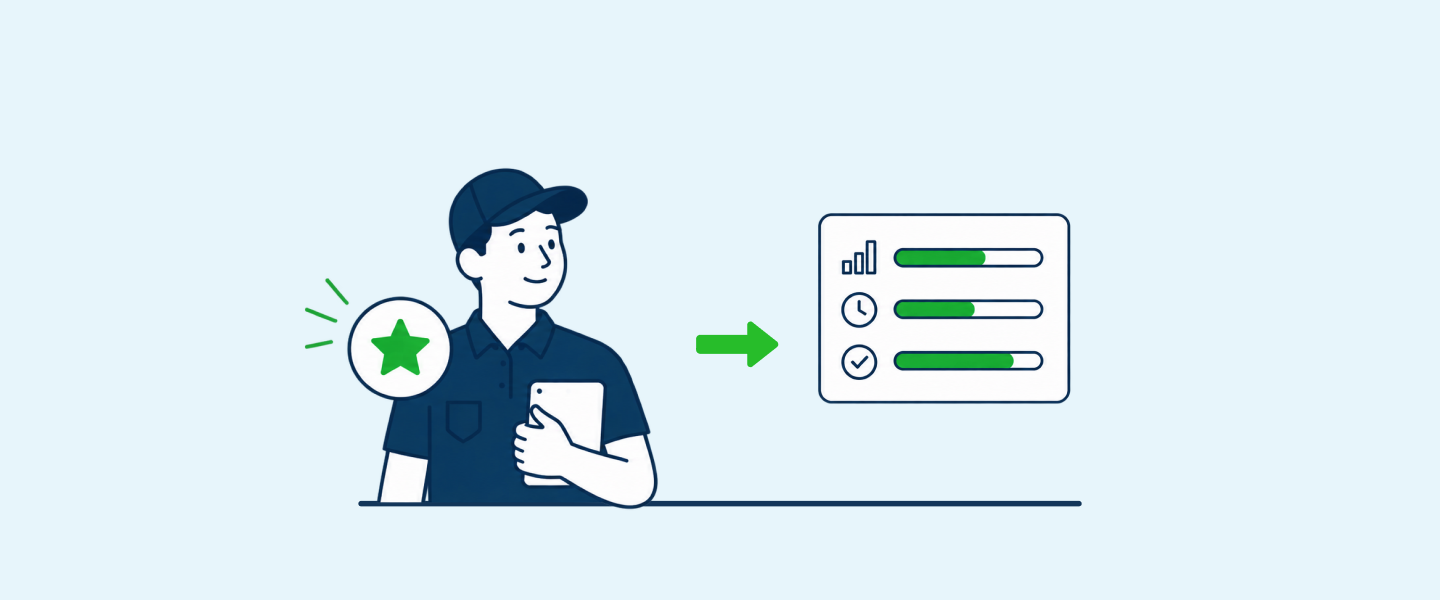
- They can’t see how they’re doing. Performance data usually lives in spreadsheets that techs never see. A tech won’t know their callback rate is climbing or their NPS is slipping until a manager brings it up, often weeks later.
- Business goals don’t translate to the route. Owners think in revenue, retention, and margin; Techs think in stops. A demand to “grow revenue” means little on the eighth stop of the day unless it’s tied to a specific action a tech can directly influence, like asking for a review or providing proof of service at every stop.
- The extra effort isn’t rewarded. Inspecting beyond the scheduled service, writing detailed notes, and submitting leads all take time. On a route paid by the stop, that time comes out of the tech’s pocket.
- Incentives are too slow or too complicated. A quarterly bonus based on six metrics feels too far away to change what a tech does today. 79% of technicians prefer performance-based cash bonuses, and those bonuses work best when they are paid instantly when the behavior is performed in the field.
The good news is that every one of these barriers is fixable. And once they’re removed, the gap between average and top-performing techs becomes clear.
The Top 5 Habits Top-Performing Pest Control Technicians Do At Every Job
1. Finish Their Route Without Cutting Corners
A rushed stop might save 10 minutes today, but it often costs a full visit next week. Every callback takes a slot that could have gone to a paying customer, and a customer who sees the same ants twice starts wondering what they’re paying for. That’s why top performers plan their route the night before and keep their truck stocked, saving time between stops so they never have to save it during one.
Building the Habit Into Your Team Culture
First, don’t measure techs on speed alone; Score techs on stops completed and re-service rate together, so a fast tech with frequent callbacks doesn’t look like a top performer. Set a time-on-site floor and ceiling for each service type, and assign every callback to the tech who did the original job.
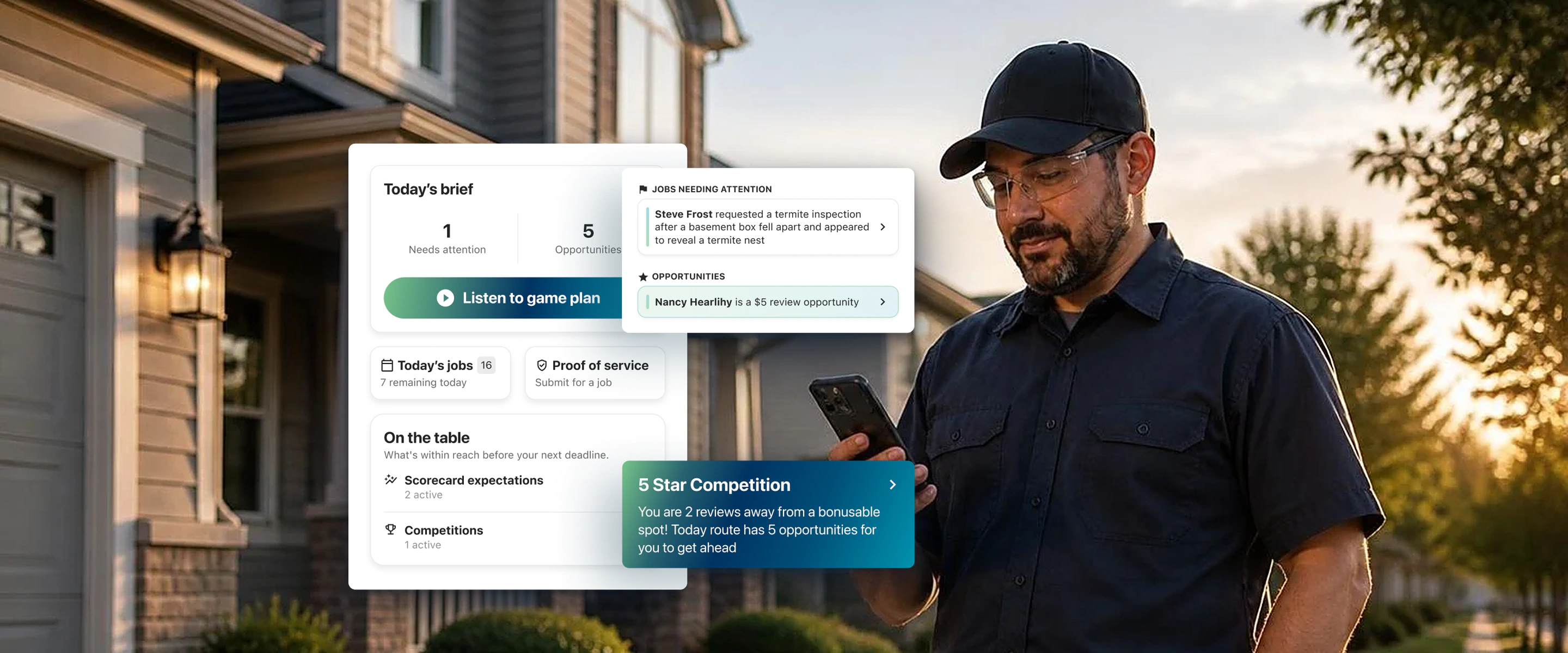
Additionally, consider getting your techs on Performance AI. It surfaces customer context, historical NPS, review and revenue opportunities, and the jobs that need attention in a simple audio Daily Brief, so your techs no longer have to sit idle for minutes in the truck to scour service notes and reviews to get all the context necessary to perform at their best.
2. Inspect Beyond the Scheduled Service
Even if a job primarily isn’t about an inspection, top-performing technicians treat every scheduled visit as one. They walk the property looking for entry points, moisture and other conditions that attract pests, then document what they find and recommend a fix. Average techs will do what the base job calls for, such as spraying the same baseboards and perimeter every visit, and move on.
Top performers conduct this inspection because consulting builds greater trust in the service your company provides and gives these techs an opportunity to maximize revenue on their existing route.
Building the Habit Into Your Team Culture
Instill inspection best practices into every service type. Give techs a short, conducive-conditions checklist to ensure they don't miss common entry poitns for pests, such as door sweeps, weep holes, utility penetrations, mulch against the foundation, and standing water.
When they flag something, have them submit a Tech-Generated Lead with a photo or video so the office has what it needs to follow up with the customer.
3. Leave Detailed Proof of Service Notes, Photos and Videos
On a quarterly plan, many customers never see their technician. If the only evidence of a visit is a line on their bill, it’s easy to start wondering whether the service is worth it.
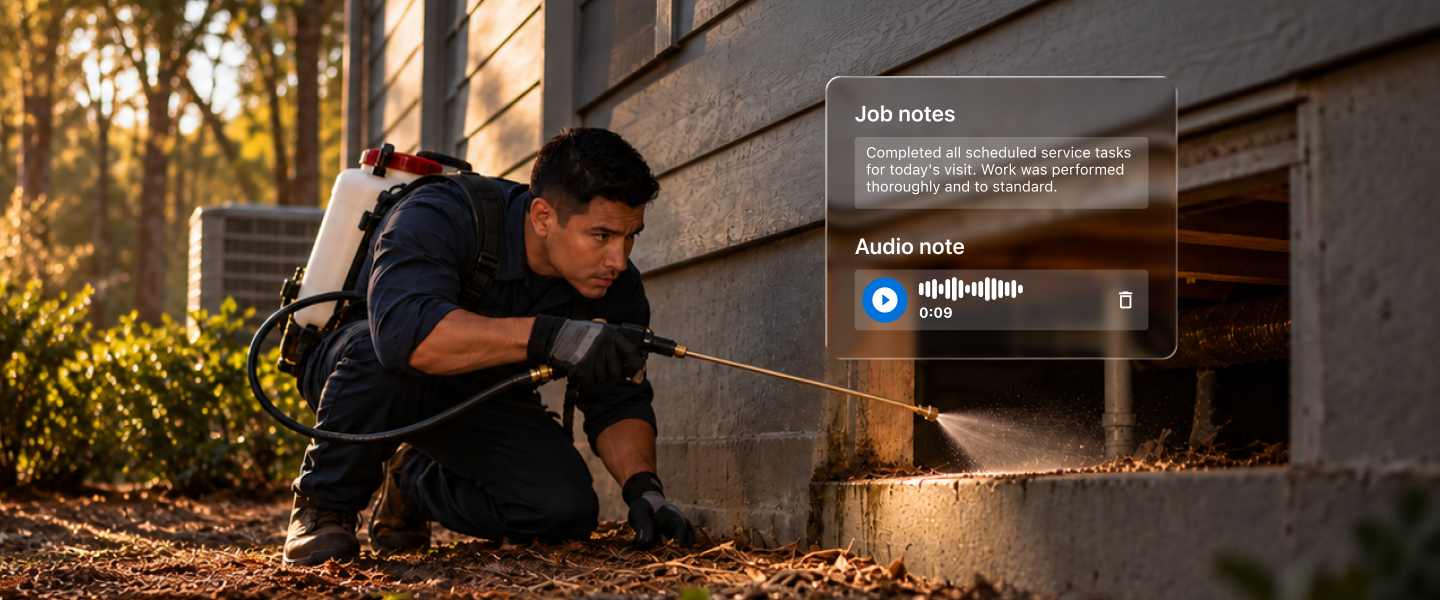
Top performers make sure customers see the value of every visit, even when no one is home. They provide a service report with photos, the products/chemicals applied to address ongoing pest problems, any additional pest issues they could see arising, and recommended next steps.
Comparatively, average techs leave a generic note, or nothing at all, and the customer is left wondering the value they’re getting from their maintenance plan.
Building the Habit Into Your Team Culture
Owners can make this the standard by defining the two or three photos or other media required for each service type. This could be taking a video of where techs left bait stations, how they treated common entry points, and where/if they found any active pest activity. Take the best Proof of Service examples across your team and share that one standout report in weekly meetings so the team sees and understands what excellence looks like.
Applause’s Proof of Service features make this a requirement for closing a job. We then tie Proof of Service into the same experience where customers submit NPS responses, reviews, and tips to create a more complete post-service journey and follow-up for techs who visit the site in the future.
4. Communicate with Customers Before and After Every Visit
Many cancellations start when a customer feels ignored, like when a missed visit goes unacknowledged or a tech sprays and leaves without a word.
Top performers keep customers informed from start to finish. They send an “on my way” text, knock before treating when the customer is home, walk them through what they found and follow up afterward. Average techs show up, treat and leave, and the customer only hears from the company when the bill arrives. Usually, you can bridge the communication gaps between your average and top-performing techs by providing necessary context and coaching.
Building the Habit Into Your Team Culture
Owners can build strong communication habits throughout their team by pairing average performers with your best communicator for ride-alongs and role-playing tough conversations in morning huddles. Each week, provide your team with one great and one critical piece of customer feedback and discuss how to handle the critical one and what the top-performing tech did that led to the great review.
To provide the context on every job necessary for techs to perform at their best, consider utilizing Performance AI. Performance AI briefs every tech on what to prioritize on every stop, flagging low NPS scores, past issues, and revenue-generating opportunities.
5. Grow Revenue Through Consultation Instead of Pitching
Most customers don’t want to buy more services; they want the ants to stop coming back. Top performers connect what they find on the property, like an entry point by the garage or mud tubes along the foundation, to problems customers already care about. When they show the customer the issue and explain what it means, the recommendation feels genuine instead of a sales pitch. Average techs either stay quiet or pitch services the customer doesn’t need.
Building the Habit Into Your Team Culture
Make the path to finding and operationalizing revenue-generating opportunities clear and financially incentivize techs to perform those activities. This is one of the core reasons why we launched Tech-Generated Leads.
With Tech-Generated Leads, technicians can submit leads by talking to AI in the Applause app or using the traditional form, and then AI helps identify the customer, suggest the service, and gather the details needed for a strong submission. Owners can then set rule-based bonuses, based on factors like photos, videos, note length, customer conversations, and more, to incentivize techs on lead quality and outcomes, not just lead volume.
Turn Every Technician Into a Top Performer
Remember the two technicians from the start of this article? Both do great work. The difference is that one has built the habits that turn every stop into an opportunity, and the other hasn’t been shown how.
Those habits aren’t a mystery: finishing the route without cutting corners, inspecting beyond the scheduled service, leaving detailed proof of service, communicating before and after every visit, and consulting instead of pitching. None of them require a larger budget; they require clear expectations, real-time visibility into performance, and rewards that arrive while the work is still fresh.
Start making one or two habits a focus that would make the biggest difference for your team this season. Coach them every week, celebrate the techs who get it right, and watch your average technicians start performing like your top performer.
Want a step-by-step plan for turning technician performance into growth? Download The Ultimate Guide to Transforming Technician Performance Into Your Best Channel for Retention & Growth to learn how to connect business goals to your techs’ daily actions so you can ensure you keep your best customers and technicians for the long haul.